
Why Entertainment Recap Channels Outlive the Trend Channels Around Them
Why entertainment recap channels tend to outlast the trend channels around them.
# Why Entertainment Recap Channels Outlive the Trend Channels Around Them
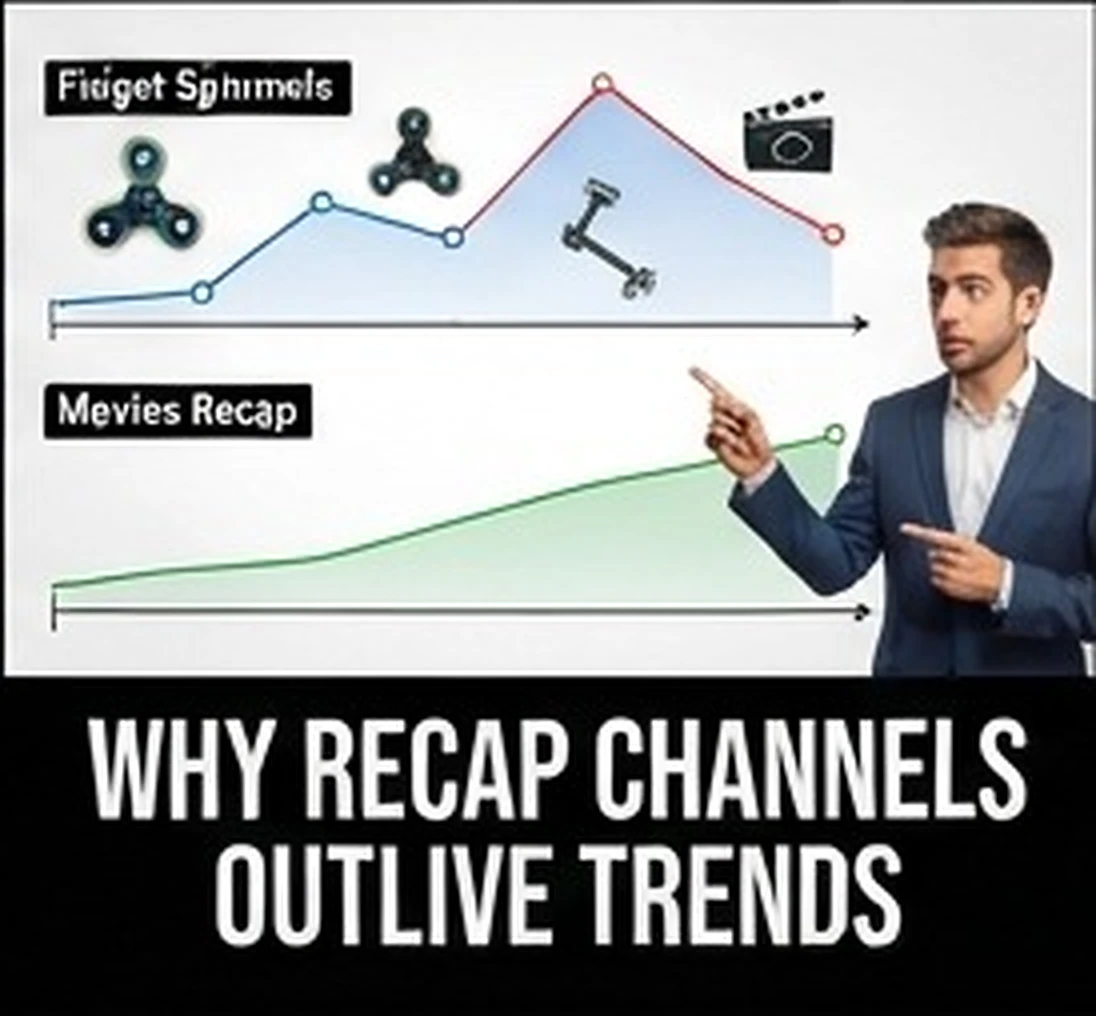
There is a visible difference in lifespan between two kinds of faceless channel that appear superficially similar. Both use existing footage, both run narration over clips, both operate in entertainment.
One covers whatever is currently popular. The other covers the same handful of shows and films with increasing depth, year after year. The first grows faster and dies sooner. The second grows slowly and is still uploading long after the first has stopped.
The mechanism behind that is worth understanding, because it changes what you should build.
Trend channels rent their audience
A channel built on current interest gets its views from a wave that is passing through. The show is airing, the film just released, everybody is searching, and the content finds an audience easily.
Then the wave moves. The show ends, the discourse dissolves, and the entire library becomes near-worthless overnight, because nobody searches for last season's discourse.
The channel now has to find the next wave, and the next one after that, permanently. Every video is a fresh acquisition problem. The library, which on a healthy channel becomes an asset that generates views on its own, generates almost nothing.
That is a treadmill rather than a business, and the exhaustion it produces is why those channels stop.
Deep-catalogue channels own theirs
A channel covering a finished series with a durable fanbase operates completely differently.
The audience is not passing through. People discover the show years after it aired, watch it, want more, and go looking. That demand is continuous rather than seasonal, which means a video published two years ago still gets found by someone who just finished the finale last night.
The library compounds. Each new video introduces people to the back catalogue, and the back catalogue keeps introducing people to the channel. Growth comes from accumulation rather than from constantly winning new attention.
The trade is that the initial climb is slower, because you are not riding anything. You are building.
Depth is a competitive moat
The other advantage is harder to copy.
A channel that has covered a series across dozens of videos develops something a newcomer cannot quickly replicate. Not just knowledge, though that matters, but a demonstrated perspective on the material that an audience has come to trust.
When a viewer wants an argument about which character was actually the smartest, they do not want the first video that appears. They want the channel that has clearly thought about the show for years, because that channel's answer carries weight.
Trend channels cannot build this, because depth requires staying in one place, and staying in one place is the opposite of chasing trends.
The material is finite, which is a feature
The obvious objection is that a finished series has a limited number of videos in it. That is true and less limiting than it sounds.
A show with a substantial run supports rankings, character studies, timeline explainers, comparisons across characters, moral arguments, plot analyses, real-world comparisons, and every combination of those. The angles multiply faster than the source material runs out, because the material is not the topic. The audience's ongoing arguments about it are.
The constraint is real at the extremes. A show with one short season does not support a channel. But the fandoms that sustain long-running recap channels are the ones where people are still arguing about the ending years later, and arguments are inexhaustible.
Building for the long version
If you want the durable model, a few decisions follow directly.
Pick material with a proven long tail rather than material that is currently peaking. Something people are still discovering, still recommending, still fighting about.
Build videos that make sense to someone watching two years from now. Avoid framing that ties the video to a moment, because the moment expires and the video expires with it.
Go deeper rather than wider. The fourth video about a single character will outperform the first video about a fourth show, because depth is where the trust accumulates.
And accept the slower start. The trend channel will be ahead of you for the first six months. It is also the one that will not exist in two years, and the videos you published in month three will still be earning long after it is gone.
The most valuable thing a faceless channel can build is a library that keeps working without you. That is only available in material people will still care about after the conversation has moved on.